On-line consultation ordering |
|
 |
|
Price list
Price list for patients up to 22 years of age with Czech health insurance (valid until 12/2025)
| Consultation - 1st visit with a written recommendation from your dentist | free of charge |
| Consultation - 1st visit without a referral from your dentist | 660 CZK |
| Consultation - 1st visit without a referral from a dentist in AJ or in CZ with your own translator | 1 320 CZK |
| Foil braces - solution of minor defects in both jaws with treatment duration up to 8 months | 86 500 CZK |
| Foil braces - solution of moderate defects in both jaws with a treatment duration of up to 12 months | 105 500 CZK |
| Foil braces - complete treatment in both jaws suitable for all defects MOST COMMON | 119 700 CZK |
| Fixed appliance - complete treatment in both jaws with metal fixed appliance | 87 000 CZK |
Price list for adult patients (over 22 years old) with Czech health insurance (valid until 12/2025)
| Consultation - 1st visit with written recommendation from your dentist | free of charge |
| Consultation - 1st visit without a referral from your dentist | 660 CZK |
| Consultation - 1st visit without a referral from a dentist in AJ or in CZ with your own translator | 1 320 CZK |
| Foil braces - solution of minor defects in both jaws with treatment duration up to 8 months | 97 500 CZK |
| Foil braces - solution of moderate defects in both jaws with a treatment duration of up to 12 months | 120 500 CZK |
| Foil braces - complete treatment in both jaws suitable for all defects MOST COMMON | 137 700 CZK |
| Fixed appliance - complete treatment in both jaws with metal fixed appliance | 125 000 CZK |
Price list for patients without Czech health insurance (valid until 12/2025)
| Consultation - 1st visit without doctor's recommendation | 660 CZK |
| Consultation - 1st visit without doctor's recommendation in AJ or in CZ with own translator | 1 320 CZK |
| Foil braces - solution of minor defects in both jaws with treatment duration up to 8 months | 103 500 CZK |
| Foil braces - solution of moderate defects in both jaws with a treatment duration of up to 12 months | 125 500 CZK |
| Foil braces - complete treatment in both jaws suitable for all defects MOST COMMON | 141 500 CZK |
| Fixed appliance - complete treatment in both jaws with metal fixed appliance | 130 000 CZK |
All prices are approximate.
The exact price can only be determined after an orthodontic consultation in our office, depending on the extent of the orthodontic treatment.
ATTENTION - from 1.1.2022 insurance companies will only pay for orthodontic treatment for patients under 22 years of age.
Payment options
We have contracts with all Czech health insurance companies. They partly cover treatment of both children and adults. Apart from payments for treatment which are paid by health insurance companies directly to our office, there is also extra refund available for patients. If a patient goes to his health insurance company with a proof of payment from our office after having fixed braces attached, they can get a refund up to 3000 CZK.The amount can be changable during a year, it depends on financial conditions of health insurance companies and on getting some other bonuses from them previously (e.g. vaccination).
A price for every patient differs. It depends on seriousness of a defect and on extent and a type of used material. A price for treatment with fixed braces can be 5000 CZK but it can also be much higher. Our patients are told final price for whole treatment from beginning till the end when we set their treatment plan. Some medical practices inform only of a price for attaching braces, but patient is not informed about prices of subsequent procedures.
Price includes whole treatment from beginning till the end. Usually it means all material for attaching fixed braces, all material needed during all further check-ups, all medical procedures which aren't covered by health insurance companies, and also material and procedures for taking braces off (fixed retainers, removable retainers). The same applies to aligners treatment
Fixed braces
Whole amount for treatment by fixed braces is paid in three instalments. Around 40% of the price is paid at beginning of the treatment, another 40% are to be paid in 6 months since the treatment has started and the rest of the amount is paid on the day braces are taken off. First and second payments come on one invoice (possible to pay in cash, by card or bank transfer), the third payment is on a seperate receipt (paid in cash or by card on the day when braces are taken off). If you choose premium material, the additional charge is divided into the first and second payment for braces.
Aligners braces
1/3 of the whole amount for treatment by aligners braces is paid at beginning of the treatment. The rest of the price is to be paid in 6 months since the treatment has been started.
Teeth on credit
We realize that prices for an orthodontic treatment are high. Not everyone can afford the treatment easily. That's why we cooperate with a company "Teeth on credit", which provides loans for a dental treatment. More information on www.uvernazuby.cz.
Dental Monitoring - modern control of your treatment |
|
|
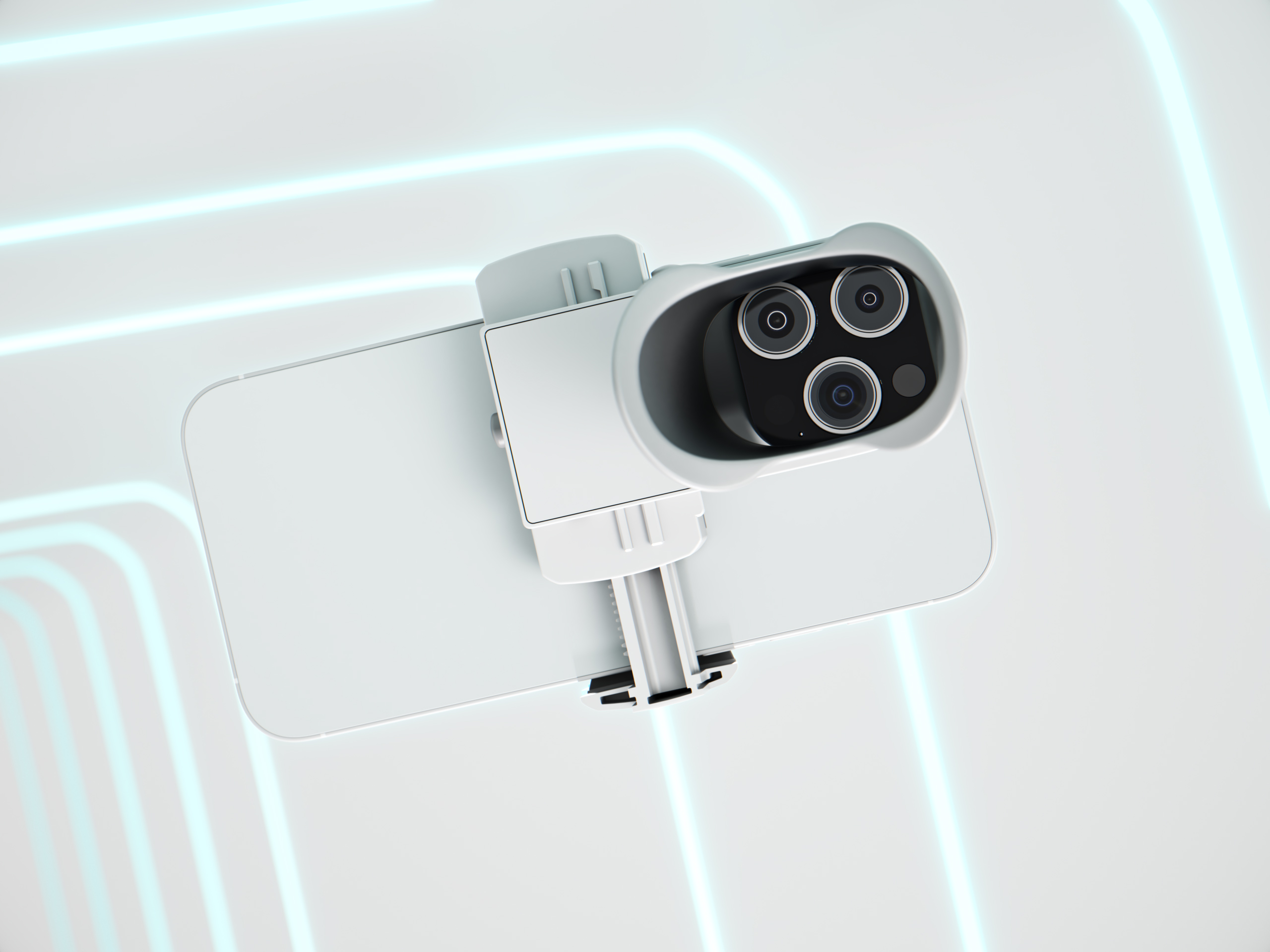
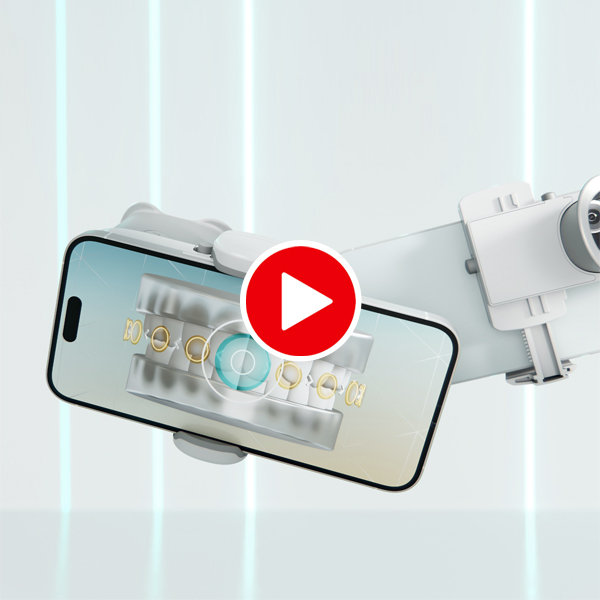
Dental Monitoring is a smart system that uses artificial intelligence to allow the doctor to monitor the progress of orthodontic treatment. With an app on your smartphone and simple scans from home, your orthodontist can regularly check your teeth and see if they are straightening as planned. If there is any deviation, the doctor will catch it in time. With Dental Monitoring, the number of office visits is reduced while treatment is much more controlled. This system brings convenience, confidence and a modern approach to orthodontic care - your braces are under control anytime, anywhere. |
|
Results of treatment
 |
 |
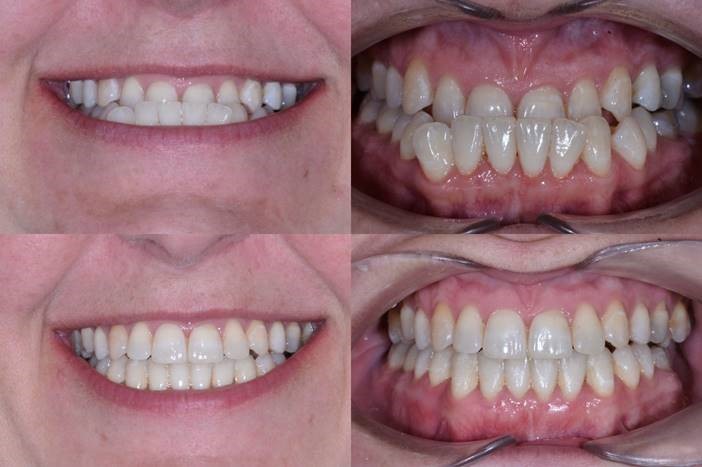 |
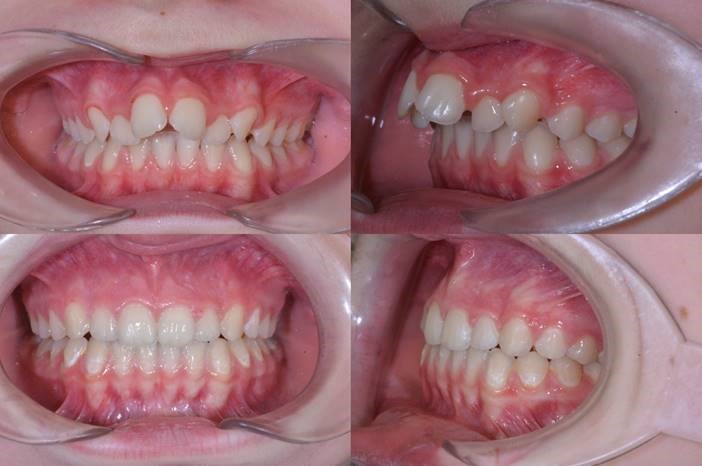 |
Life with braces
Start of the treatment
Just after having braces attached, your teeth will be very sensitive when chewing. This should stop after a week when the teeth need get used to the pressure of braces. The teeth don't straighten at that time. They will start straightening a second week, after their sensitivity fades away.
Cleaning teeth with braces
No matter what type of braces we use, intensified oral care is necessary for the whole time of your treatment. The teeth should be moving only in healthy environment. Neither tartar nor gum infection should be present in your mouth, otherwise periodontium may get damaged (receding gums). If fixed braces are used, a lot of new tight areas will appear on your teeth, which need to be cleaned very carefully. After having the braces attached, right technique of brushing is shown to our every patient using a dummy. We don't recommend using mouthwash too often (it can cause staining) and rather pay attention to proper brushing with toothbrush.
Food
Aligners braces won't limit what you can eat. They are taken off before eating. If you have fixed braces, you need to avoid hard and sticky food. It is necessary to avoid food like fried bread, carrots, nuts, hard apples, caramel, etc. If any bracket gets loose it always means an immediate (after phoning us) visit of the office. Debonded bracket causes movement of the tooth back to its original position and restraghtening will needlessly make the whole treatment longer. Therefore dont hesitate and solve any problems with braces immediately.
Medication
Some medication slows down the teeth movement. Especially medication used for fever and pain relief: Ibuprofen, Ibalgin, Acylpirin, Aspirin. Anti-inflammatory drugs considerably slow the treatment down as well (eg. for rheumatoid arthritis), eg. Metotrexat. We recommend avoiding these drugs during your treatment or asking your doctor for some substitutive medication. In case of high fever or pain we recommend using Paralen / Paracetamol which doesn't affect straightening teeth.
Sport
Most of the sports can be done without any limits. If you do contact sports, we recommend using a teeth protector which is necessary to reshape regularly (after warming up in warm water) according to a quickly changing position of your teeth.
Music instruments
You should be able to play music instruments without any limitation two weeks after having braces attached. Professional trumpet (and similar instruments) players can be using aligners braces or braces behind teeth (lingual braces) which should not influence their performance.
Pronunciation
Lingual braces (attached behind the teeth) can temporarily cause worse pronunciation. Other types of braces don't usually cause any considerable issues with pronunciation.
What to do and what to expect after getting braces
1) Tooth sensitivity
The most uncomfortable time with braces is the first week after getting them on. Your teeth need to get used to the fact that we are starting to move them. Their natural reaction is increased sensitivity. Teeth are sensitive to biting. Therefore, only soft foods should be eaten in the first week after braces are fitted. Some patients feel that if the teeth do not hurt during treatment, they do not straighten enough. However, the opposite is true. When the teeth are sensitive at the beginning of treatment, they do not straighten at all. It is only when this sensitivity subsides (after about one week) that the teeth begin to move.
2) Brushing the teeth
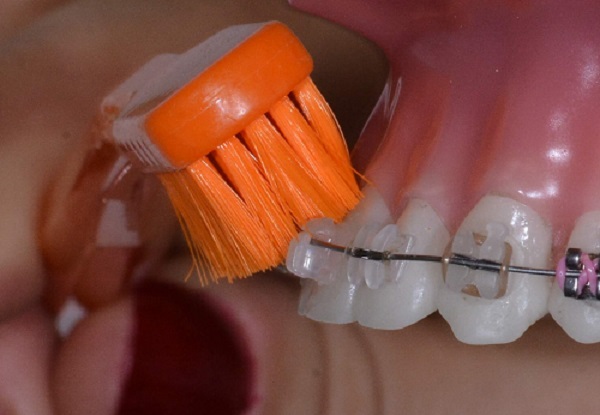
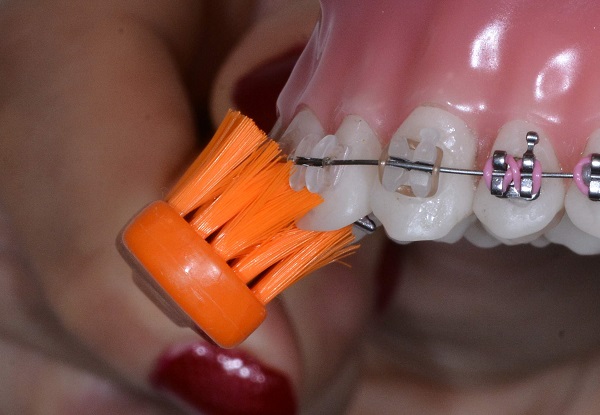
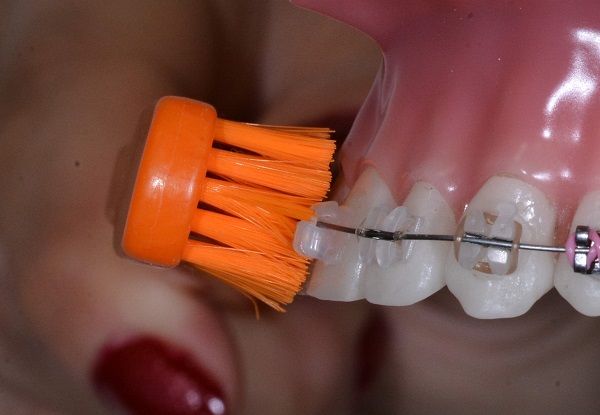
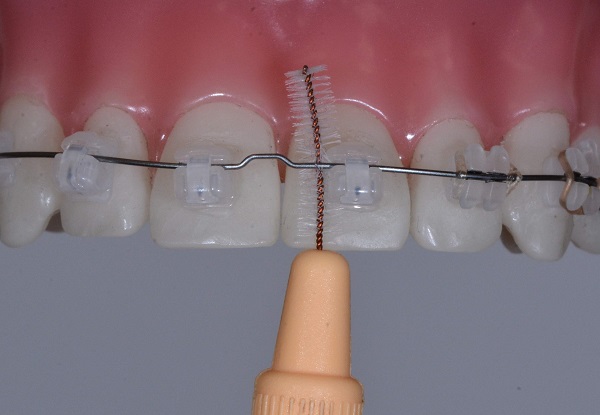
During orthodontic treatment, it is necessary to pay careful attention to oral hygiene. Hygiene with foil braces is the easiest. They are taken off to clean the teeth, so the patient cleans as before. With fixed appliances, the braces create many new nooks and crannies. There is no need to brush your teeth after every meal. Twice a day is enough, but with precision. The entire surface of the teeth must be cleaned thoroughly. Most attention should be paid to the area under the wire and between the lock and the gum. We recommend getting a soft toothbrush with a large number of bristles. Turn the toothbrush diagonally away from the gum line and use small rings to clean the area between the gum and the lock (Fig.1), then turn the toothbrush away from the edge of the teeth and again use small rings to clean (Fig.2). For a pleasant mouthfeel, it is a good idea to clean the brackets themselves (Fig.3). In the evening before going to bed, it is also advisable to use a large interdental toothbrush and clean the spaces between the locks (Fig.4).
 |
 |
 |
 |
3) Food
Fixed braces can only be bonded to the teeth so strongly that we can safely remove them after treatment. Therefore, hard food (toast, nuts, carrots, etc.) must be avoided, as well as biting into pencils, toothbrushes, etc., to prevent the brackets from coming loose from the teeth. If a lock happens to come loose, an appointment for repair should be made as soon as possible. A tooth that does not have a lock on it will immediately begin to travel to its original location. If the patient neglects this and does not have the lock repaired until, for example, a week later, this means that the tooth has become crooked in the meantime and we have to realign it. A week's delay can mean 2-3 months longer treatment!
Orthognathic surgery
Jaw surgery
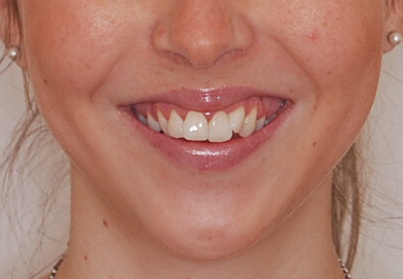
It is not possible to solve all orthodontic problems only by braces. In case that wrong bite is caused by a bad growth of the jaws during the puberty, braces themselves won't often do and it is necessary to undergo a jaw surgery to achieve an uncompromising result.
If it is possible to improve an operation defect without an operation, we create an operation plan as well as the other one, without an operation, so called compromising (the occlusion won't be perfect, the face doesn't have to look as nice as after surgery, etc.). A patient makes his choice. Only extreme defects require solely ortho-surgical intervention.
During consultations in our office we are most often asked the following questions:
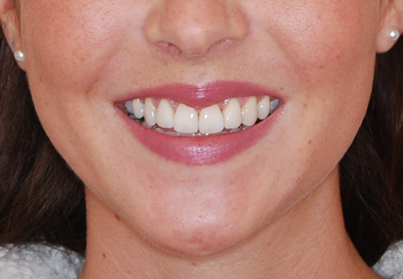
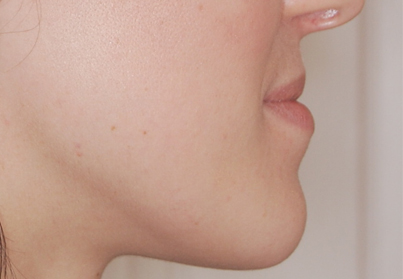
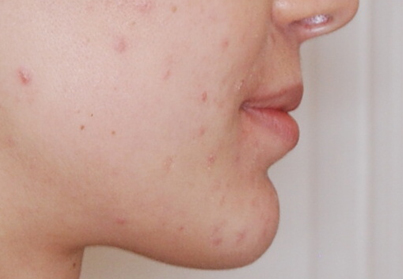
What defects are solved by jaw surgery? |
|
 |
|
| BEFORE SURGERY | AFTER SURGERY |
 |
 |
 |
 |
At what age is surgery performed?
Not before the age of 18. In women, who started menstruating very early (at the age of 11), surgery is possible at the age of 17. To perform surgery is is necessary the growth of the face has been finished.
Does it hurt?
A patient is put into a deep sleep under general anesthesia. Patients usually don't complain about pain after surgery. They stay in hospital for 5-7 days after surgery, that's when unpleasant healing is going on and painkillers ease the pain. Patients suffer more from facial swelling than pain, which can last up to 6 weeks.
Another oddness is that just as during fracture healing (eg. an arm) it is necesarry to immobilize the bones for 6 weeks. Immobilizing jaws is secured by a higher number of elastics between upper and lower braces which keep upper and lower teeth together. Elastics are removed only for brushing the teeth. A patient can consume only liquid diet three weeks after surgery. It is possible to gently bite between 3rd and 6th week. The side effect of jaw operation is losing a bit of weight which is appreciated by most of the patients. Pronunciation with elastics isn't usually a big problem. Patients learn quickly to talk with their teeth together. After 6 weeks, swelling disappears, elastics are worn only occasionally, a patient can normally bite and pronounce.
Is there any risk?
Risk is very low in healthy people without high blood pressure and other serious diseases.
The most common problems:
- Numbness of the lower lip - the lower lip is numb after surgery. Neither mobility of the lip or its look changes, it is only numb when touched. Numbness should disappear after a few weeks or months. It rarely lasts longer. The same problem can occur after extracting the wisdom tooth, a patient isn't usually informed about it before extraction though.
- Bad bone healing - if a patient follows doctor´s instructions, especially liquid diet and wearing elastics which hold upper and lower teeth together, this complication is very rare.
- Relapse - the teeth and jaws return to their original alignment. We use all means to prevent the relapse. It always happens in a small way though. Only a significant relapse is a problem. In such a case a reoperation is necessary (it hasn't happened in our office yet).
Is it necessary to have braces for surgery?
Braces always have to be worn for surgery (bonded fixed braces or removable aligners on both jaws). Sometimes we use procedure called „surgery first“, where braces or aligners starts after surgery.
How much does jaw surgery cost?
It costs about 120-270 000 Kč and it is fully funded by Czech health insurance (if patient has one).
Unfortunately, health insurance companies don't have enough money and they limit a number of patients going to surgery every year. It means that there is a rapidly growing list at dental clinics and the waiting time can be up to four years. It is possible to pay privately for the surgery though and then the waiting list won't relate to a patient.
Surgery options:
- Surgery first - surgery is performed at the beginning of the orthodontic treatment
- Surgery early - surgery is performed after six months
- Traditional preparation - teeth are completely straightened before surgery (1-1.5 year of treatment). Surgery is followed by a short 3-6 months lasting after-treatment.
Where is surgery performed?
At specialized dental surgery clinics all over the Czech Republic, where they do jaw surgery. The best experience we have with VFN in Prague (prof. Foltán) and FN in Brno (MUDr. Liberda).